
Parallel Lives #4: Exiles
Being the endings of our tale

At last, the end! Here are the previous issues if you want to refresh your memory before continuing. Otherwise, there is a small recap ahead.


The Story so Far
Peru has achieved what the Napoleonic wars, politicians in the United Provinces and royalists in Chile could not: General José de San Martín has been defeated. His political tutelage as Protector of Peru has come to an end, unable to break the military deadlock and hounded by Peruvians that wish him gone. Giving up his powers, he sails now toward Chile and a retreat from public life.
Now is the time for Simón Bolívar. San Martín’s departure has cleared the way for the President of Gran Colombia to face the last viceroyalty. Here is the chance to reap the final fruits of glory—and finish the liberation of South America.
Final Liberation
You will forgive me, dear reader, if in the interest of time I quickly skip over the events that followed.
Bolívar arrived in Peru about a year after San Martín’s departure. In the time since, the situation had deteriorated: the Royalists were on the rise, Lima had been briefly retaken, and there were two divorced Peruvian governments operating in the country. After both Peruvian presidents defected to the Spaniards (in separate occasions), congress appointed Bolívar “Dictator of Peru”.
Even endowed with absolute power, it would still take another year to stabilize the situation and reconstitute the army, this time adding Gran Colombian reinforcements to the mix. Then, taking advantage of mutiny in the Spanish ranks, he and Sucre pushed into royalist territory. On the 9th of December of 1824, Sucre defeated the Spanish forces on the plain of Ayacucho, 3396 meters above sea level. There followed the unconditional surrender of the remaining Royalist forces1. Peru was free and Bolívar was its Liberator.
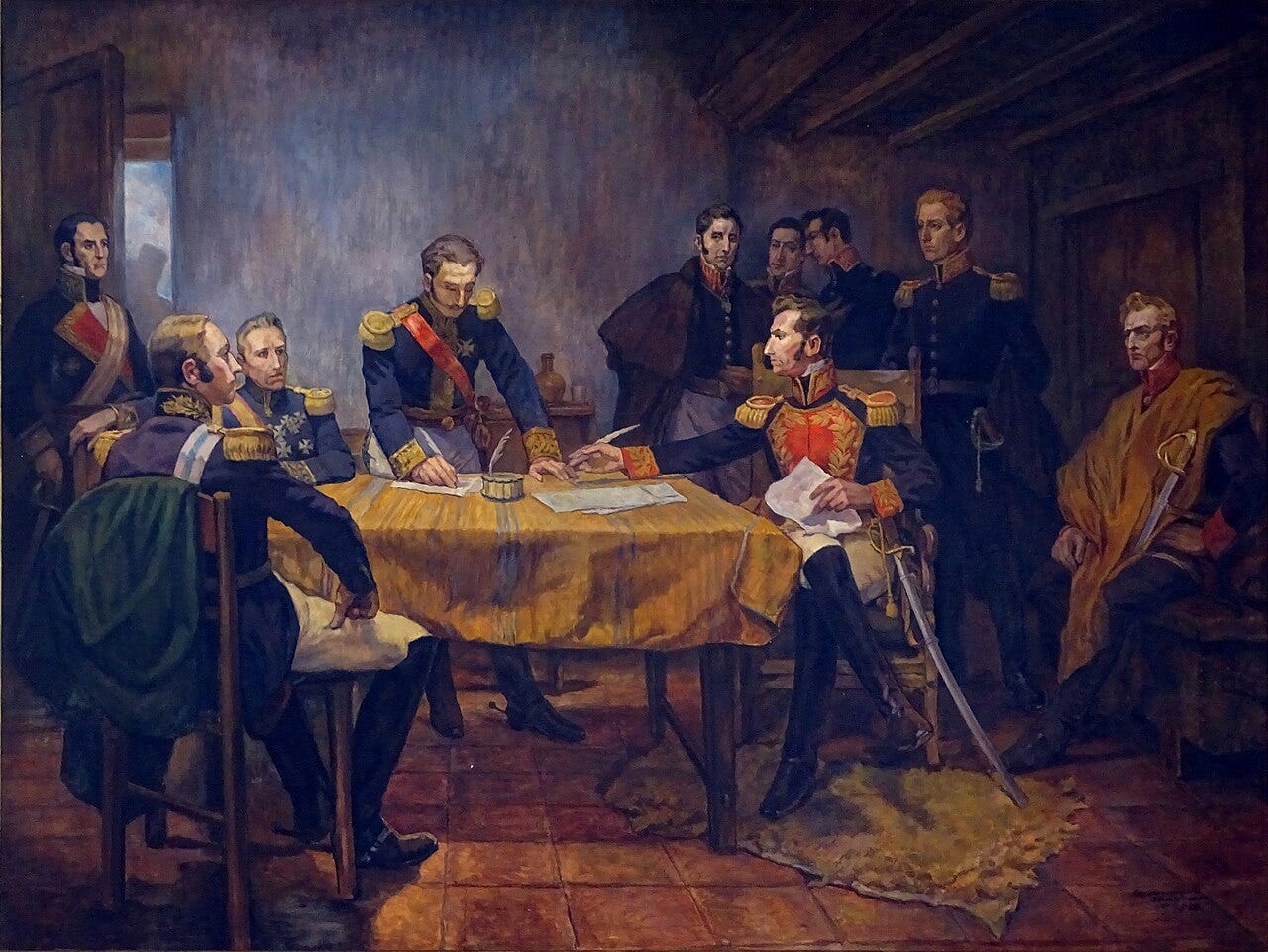

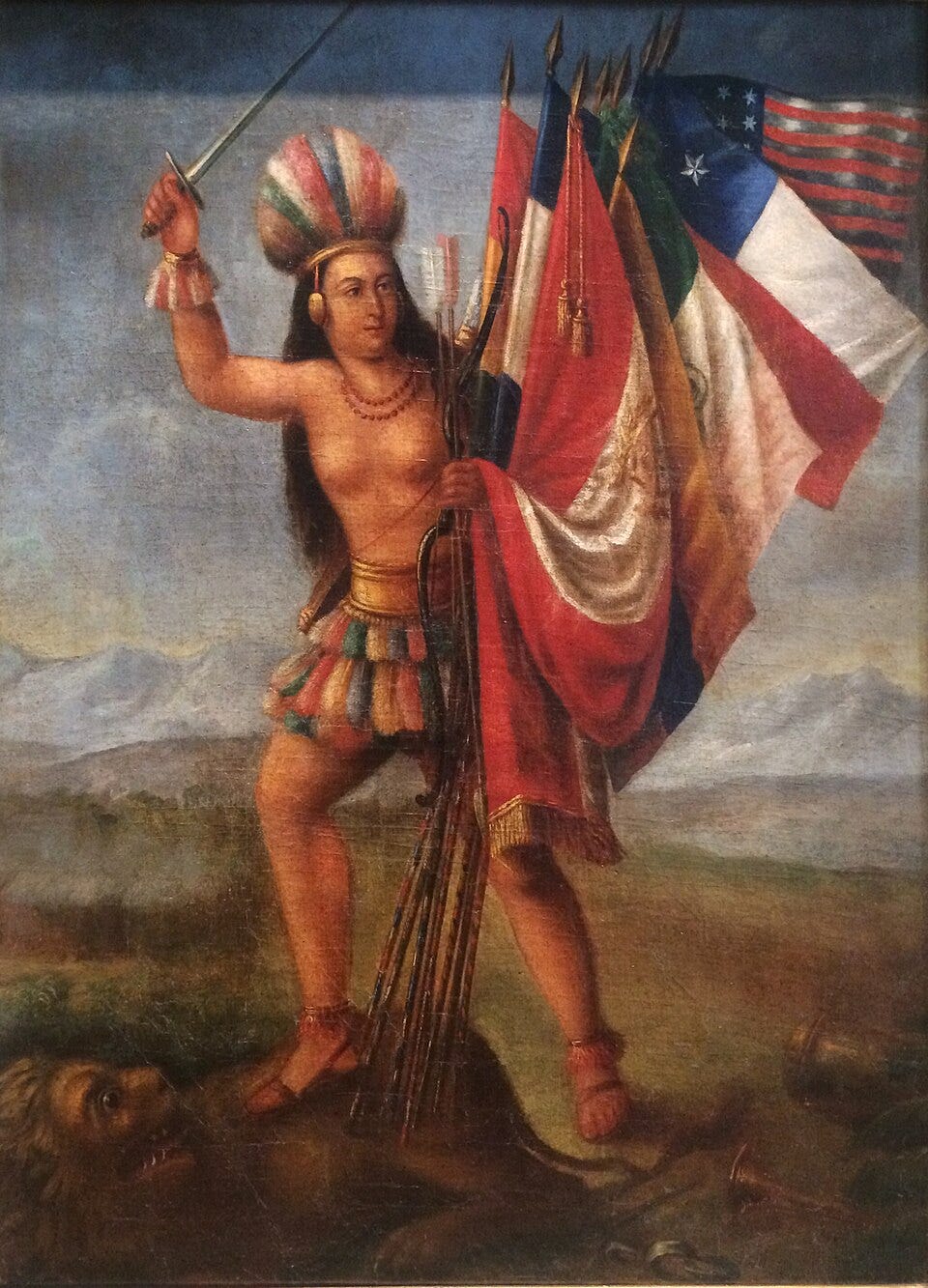
This was the high-point of his career. He was feted in Cuzco, Lima and Bogotá: cheering crowds, flags, triumphant arches and even more dancing girls in white greeted him at every city. When Sucre completed the liberation of Upper Peru (its Spaniard commander had refused to recognize the surrender in Ayacucho) he baptized the new country Bolivia in his General’s honor. Climbing atop Potosí, source of wealth and pain for the continent, Bolívar unfurled the flags of Colombia, Peru and the United Provinces so the world could bear witness to a free Spanish South America. It was the result of 15 years of warring, suffering, failures, glory, and almost superhuman exertion.
With such triumphs behind him, he could dare to dream big. He envisioned greater integration of the newly created nations. In 1826, he proposed a Federation of the Andes to join Gran Colombia, Peru and Bolivia into a larger political unit—something like Gran Colombia+. The same year, he convened an international congress in Panama with an even more ambitious goal: a league of American Republics, from the United States to the United Provinces2.
After giving up his dictatorial titles to the restless Peruvians, Bolívar returned to Gran Colombia to complete his term as president. There, he would come face to face with his creation.
The Way to the Sea
While Bolívar collected laurels, San Martín was getting accustomed to life after liberation.
His first stop after Peru was Chile. In Santiago, however, the reception was mixed; Cochrane, still stung from their last meeting, had been working on a campaign to discredit him. After a short stay in Santiago, he went over the Andes and returned to Mendoza. The unpleasant rumors, however, were a sign of what was to come.
It had always been his intention to retire in Cuyo, tending his farm away from politics. That, however, proved difficult. In a twist of fortune, the government of Buenos Aires was once again under the control of Bernandino Rivadavia, who had not forgotten San Martín’s role at overthrowing his government back in the days of Alvear. Although the former general kept silence in all political matters, the government-affiliated papers circulated rampant rumors of him wanting to seize power. Spies were infiltrated into his home’s staff; his letters were intercepted in search of conspiracies. Far from the peaceful retirement he had envisioned!
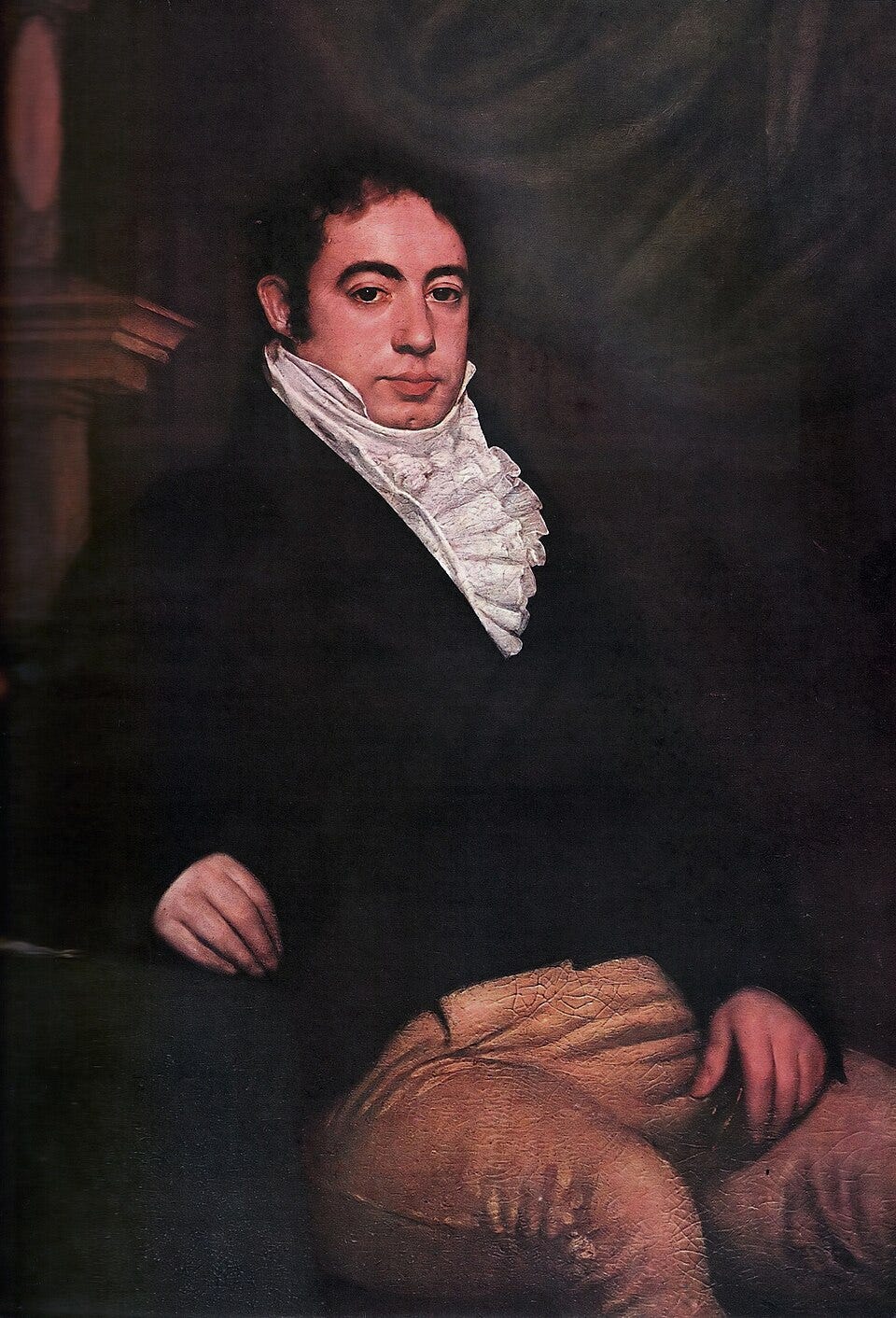

His wife’s death was a chance to break away. Remedios had been sick of tuberculosis for several months, but San Martín had remained in Mendoza while she died in Buenos Aires. There would be no reunion after the years of separation. Instead, all that remained was to go see Mercedes, their daughter, now seven years of age.
It had been clear to San Martín that he could no more remain in the United Provinces than he could in Chile or Peru. After a short stay in Buenos Aires to bury his wife and settle some affairs, father and daughter embarked for Europe; the wake of their ship left the revolution behind.
The Man of the Troubles
You can be sure that we are over an abyss, or rather a volcano that is about to erupt. I fear peace more than war.
—Letter of Bolívar to Pedro Gual
Alas! no triumph can last forever.
The political problems that plagued Bolívar in the years 1826-1830 were not new, but had remained in the background during the years of revolution. Now that the din of warfare was over and the task of governing began in the earnest, however, they became impossible to ignore.
It began with the failure of his pan-American initiatives. Nothing came out of the talks to form the Federation of the Andes, while the Congress of Panama was boycotted by some and ignored by others. Bolivarian pan-Americanism died with a whimper—for now.

Bolívar had little time to lament this turn of events, though. There were more pressing concerns closer to home. The Congress of Ocaña, meant to revise Gran Colombia’s constitution, was sabotaged by political impasse. Then, pardo rebellions, unhappy with their continued disenfranchisement under the new order, shook the country’s sense of safety. To the mix was later added war, as the new government in Peru sought to re-litigate the status of Ecuador through the force of arms. The compounding crises led to congress appointing Bolívar “Liberator President”, a custom-made title tailored to give him whatever powers were necessary for him to “save the nation".
Underlying the troubles brewed an even more concerning issue: the existence of Gran Colombia itself. The confederation was Bolívar’s project, shared with his closest supporters, but in truth it lacked an “organic” backing from the regions. The Liberator had been able to push through with its creation thanks to the momentum of revolution, but the cracks were beginning to show.
Opposition came from the two main regions of the country: Cundinamarca (former Nueva Granada) and Venezuela. In the former he faced off Santander and his liberals, who opposed his centralism and military manners; while in latter it was the caudillos who resented being ruled by the far-away bureaucrats of Bogotá. In Caracas, resistance coalesced around Páez, who had successfully bridged the transition into a wealthy landowner and Commandant General of the region. It was around the erstwhile caudillo of the Llanos that the Venezuelan elites coalesced to defend their interests.
Bolívar was thus pressured from all sides. The next four years stretched his abilities and energy to the limit, as he stalked all about the country, putting off the fires that broke out in every corner, brokering last-minute agreements to prevent further rebellion, and barely surviving an assassination attempt by a liberal conspiracy. All these he achieved through what O’Leary termed “the magic of his prestige”—that and great doses of his characteristic willpower.
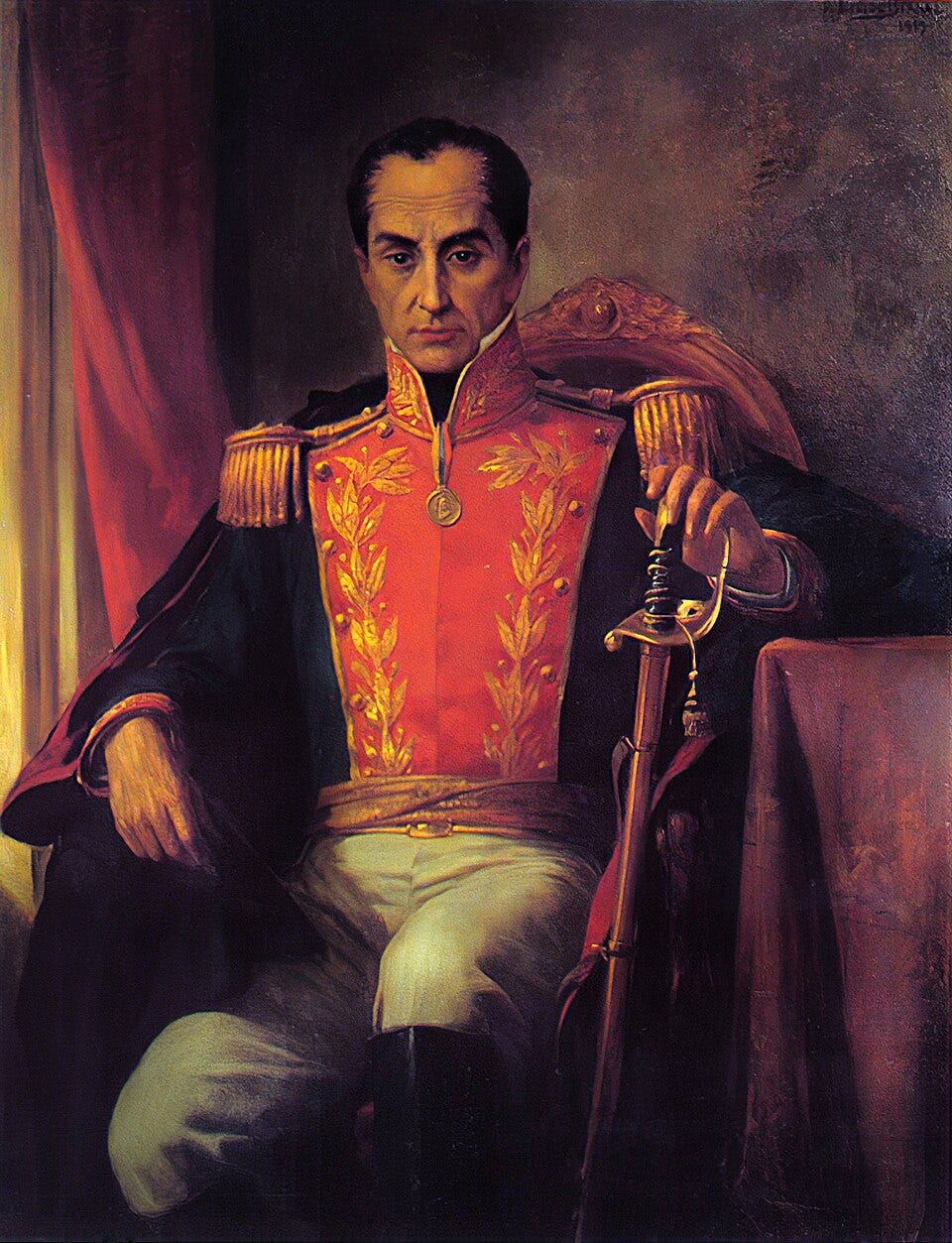

In the end, however, not even Bolívar’s willpower could keep the disparate parts together. Seeing his political possibilities narrowing, he made a last-ditch attempt to rescue the federation. He convened a constitutional congress to reform Gran Colombia as necessary. To facilitate the process, he decided to step down and on the 15th January 1830, visibly spent and weakened, he presented his resignation to the full assembly. It was to no avail. On May 6th, Venezuela seceded from the union; one week afterwards, Ecuador followed; Cundinamarca alone kept the mantle of Colombia. A condition for the peaceful secession was the expulsion of Bolívar from union’s former territories.
Thus began Bolívar’s last journey. He was unwanted, but lacked the funds to leave. From one of the largest personal fortunes in Venezuela there remained but the man’s personal effects and mementos, and a copper mine that he had been trying to sell since 1826. Still, he set forth from Bogotá on May 8th, navigating down the Magdalena river towards the Cartagena and the sea.
In Cartagena he stayed for several months, waiting for some funds that could finance a passage out of the country, perhaps to Europe or the Caribbean. He was a shadow of his former self, architect of a broken edifice, devoid of any political power and much weakened physically; yet he still stood. It would take one final blow to fell him. It came on the 4th of June, with a news like an earthquake: while on his way to Quito, Sucre had been assassinated.
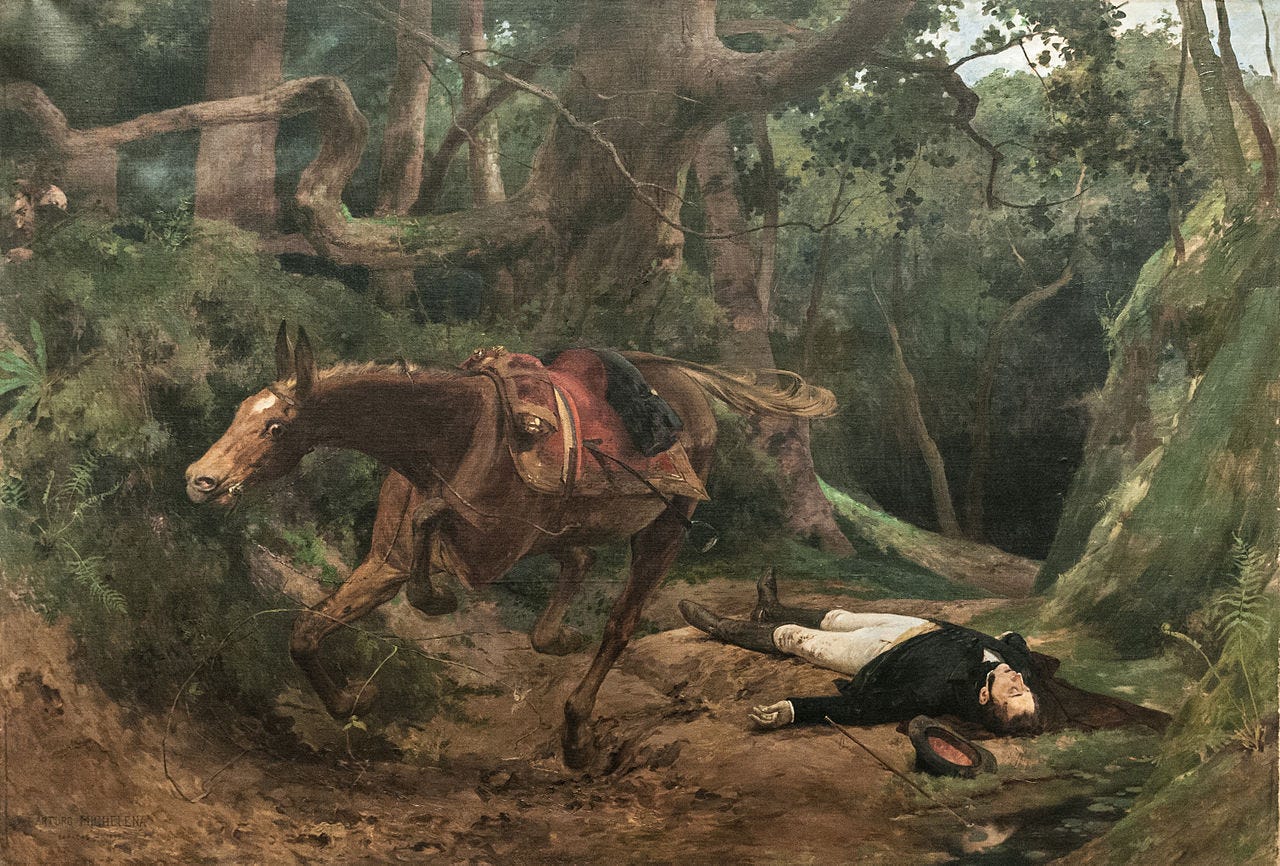

Sucre had been one of Bolívar’s closest collaborators. Young, intelligent and charismatic, Bolívar had considered him his political heir, and had hoped that he would continue his project after he was gone. But that would never come to be. The “most perfect man of the revolution”3 laid dead, bled out on a miserable mountain road. With him died also Bolívar’s last dreams.
It was in this mood that he wrote the following:
You know that I have ruled for twenty years, and from these I have derived only a few certainties: (1) America is ungovernable, for us; (2) Those who serve a revolution plough the sea; (3) The only thing one can do in America is to emigrate; (4) This country will fall inevitably into the hands of the unbridled masses and then pass almost imperceptibly into the hands of petty tyrants, of all colours and races; (5) Once we have been devoured by every crime and extinguished by utter ferocity, the Europeans will not even regard us as worth conquering; (6) If it were possible for any part of the world to revert to primitive chaos, it would be America in her final hour.
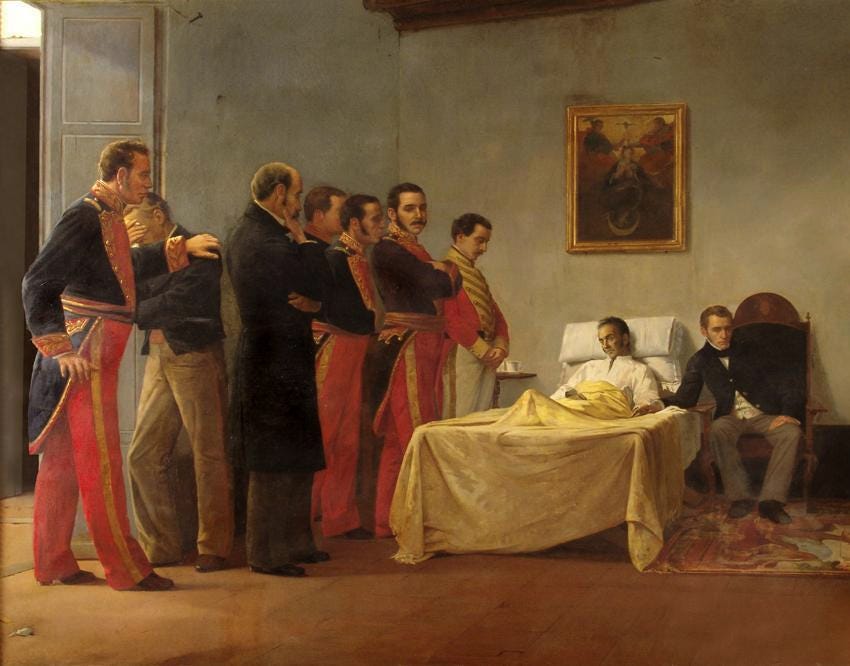
After that, the end was not long. As his health deteriorated, he was was brought out to the countryside to rest. This did not help him, and soon the bishop was called to minister the last rites. In his last, bed-ridden days, Bolívar hallucinated. “Let’s go! Let’s go!", he said. “People in this land do not want me. Come, boys! Take my luggage on board the frigate.” He died on the 17th of December 1830, likely from tuberculosis, accompanied by a small entourage of friends and collaborators who had followed him in exile.

Harborage
San Martín’s return to Europe did not mean the end of his difficulties. For starters, the trip was wretched. He had to travel across the Atlantic on a second-rate merchant ship, while reacquainting himself with a young, spoiled daughter for whom he was a virtual stranger. It could not have been an easy transition.
In France, the reception was chilly. The recently-restored Bourbon monarchy thought him a South American republican radical. After some quick paperwork, he was instructed to move on. His final destination would be London.
Fortunately, the English capital was an improvement. He knew several people there, both Britons and South American expats. Among friendlier faces, he was invited to dinners and visits, old friendships were renewed, and he was able to enroll Mercedes in a finishing school—his daughter’s education would be his last great project. Yet not even there could he escape the shadow of his reputation. London was a magnet for Argentine4 diplomats, and he had to reacquaint himself with several countrymen he may have wished to avoid; Carlos María de Alvear, for example, whose provocative comments demonstrated that he had not let go of their rivalry, and Rivadavia himself, who was so grating that San Martín almost challenged to a duel (he was dissuaded by his friends with some difficulty).
By degrees he adjusted to life in Europe, among compatriots and expats and away from the shores that had seen him fight for liberty. But fate had prepared him one more return.
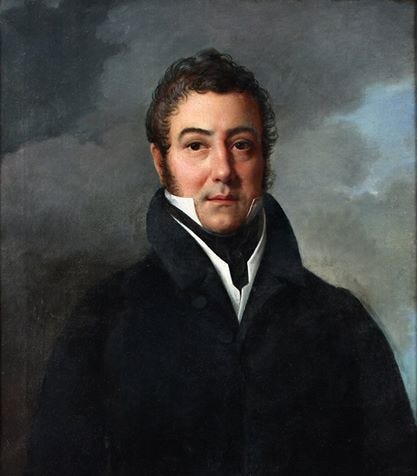
In November 1828, San Martín sailed once more for Buenos Aires. It was a necessary trip. He had a number of properties in South America, some inherited from his late wife, others gifts from the nations he had helped liberate. The rents from them represented a good percentage of his income, but with the political instability in the region the remittances had become irregular. After being forced to reduce his expenses, he decided to go see to his affairs in person.
On the other side of the Atlantic, however, he realized that he was arriving at a city in chaos. Buenos Aires had seen two consecutive coup d’états in the course of the last year and the base of the new government was not yet solid enough to rest easy. Seeing this, San Martín decided not to land, but instead go to Montevideo until the situation was clarified5.
It was the right choice. His decision to stay away was lambasted all across the political spectrum, interpreted variedly as a critique to the new regime, a snub to the opposition, a lack of patriotism or an excess of pride. Yet more concerning than the attacks were invitations. He received letters from friends and reputable personalities, friendly in tone, where they called for a savior would lead a “third option” movement that would “rescue” the country from the politicians and re-establish order by force. This benevolent dictator, it was suggested, may be close—perhaps even just across the bay of River Plate?
San Martín rejected these brazen overtures. The amount of intra-Argentine violence that would imply horrified him, and besides he thought that the institutional problems could not be solved by messianic figures. Underneath all the hubbub, however, he had to again face the lesson of Mendoza: General San Martín, Liberator of Chile and Peru, could be no private citizen in his native land. Bolívar was not the only one endowed with the “magic of his prestige”, but unlike the doomed Venezuelan, San Martín could not—would not—make use of it for political ends. Yet the mere potential of it made him a target of speculation, to the point that his mere presence was a destabilizing factor in Argentine politics.
In the meantime, in Montevideo he received a warm welcome. Uruguay, recently constituted as an independent state, had nothing but wonder for the Liberator’s fame, and he was showered by a level of attention that he endured with resignation. At any rate, his managed to accomplish his main objective: he arranged for his property’s management to be unified under a couple of administrators, and he event managed to collect several documents that had been scattered during his campaigns.
Before he left, he was once more asked by some of his friends to remain and take part in the political stabilization of Argentina. He rejected it quite plainly:
It has been many years since you know me closely and know that I have never subscribed to any party and that my operations and their results have been the daughters of my scarce reasoning and the friendly advice of my friends; there won’t be a shortage of those that say that the patria has a right to demand from their children all manner of sacrifices, [but] that has its limits; to her one must sacrifice one’s life and interests, but not one’s honor.
He returned to Europe.
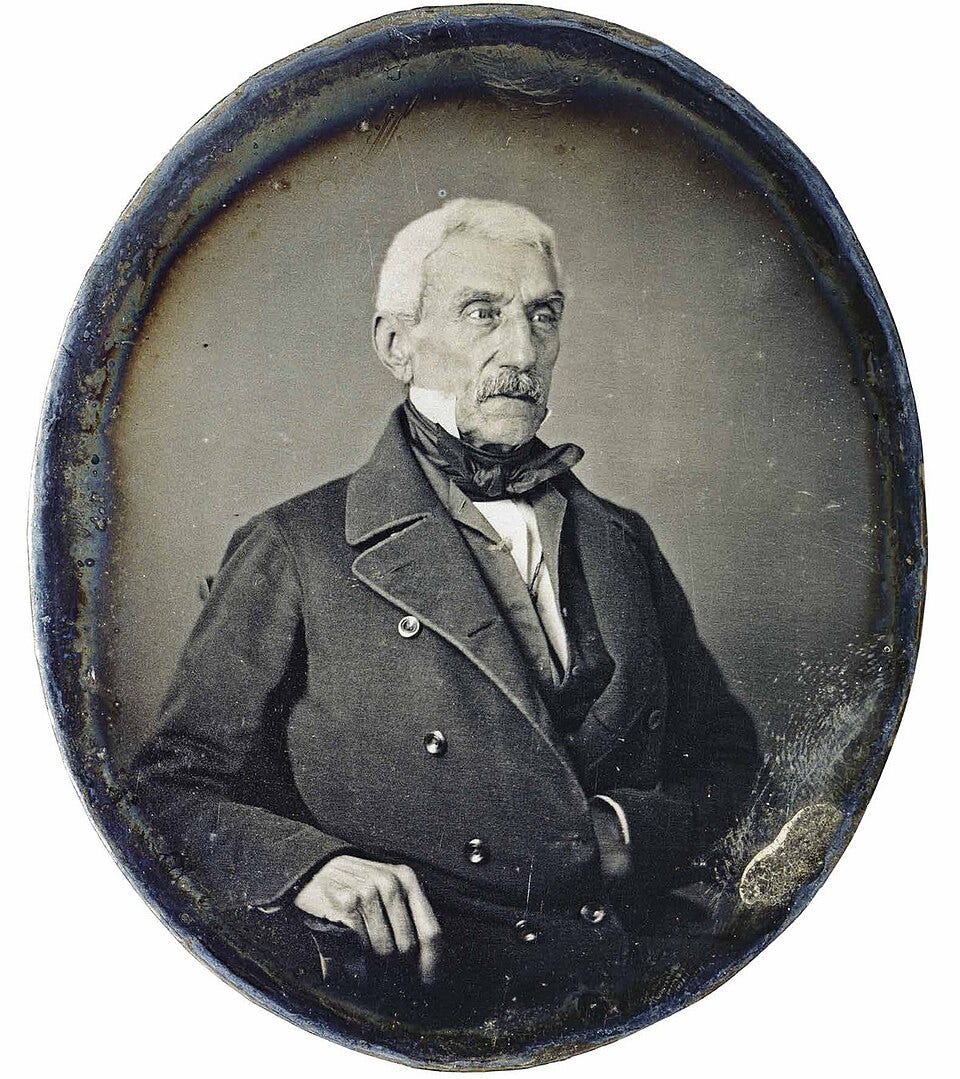

From then on, the years rolled on more gently. He lived in Brussels and then in Paris (the French had eventually warmed up to him), accompanied by his daughter. The arrangements done in Montevideo bore fruit and his financial situation improved. In 1832, he and Mercedes got sick from cholera. Durign those months of ailment, they were supported by Antonio Balcarce, attaché at the Argentinian embassy in London and son of a friend of San Martín. Love bloomed from his cares, and by the end of that year, Balcarce and Mercedes were married. Soon after, San Martín became grandfather to two little girls.
He aged. In the two decades that followed his final return, he moved to the countryside to lead a peaceable life. He dedicated himself to his pastimes: reading, cleaning his weapons, cabinetmaking, and his granddaughters. With time and distance, his reputation was restored in the countries that had once repudiated him; visitors came from Peru, Chile and Argentina to pay their respects to the Liberator in exile. He followed the events in South America from afar, keeping an active correspondence even as his eyes became riddled with cataracts.
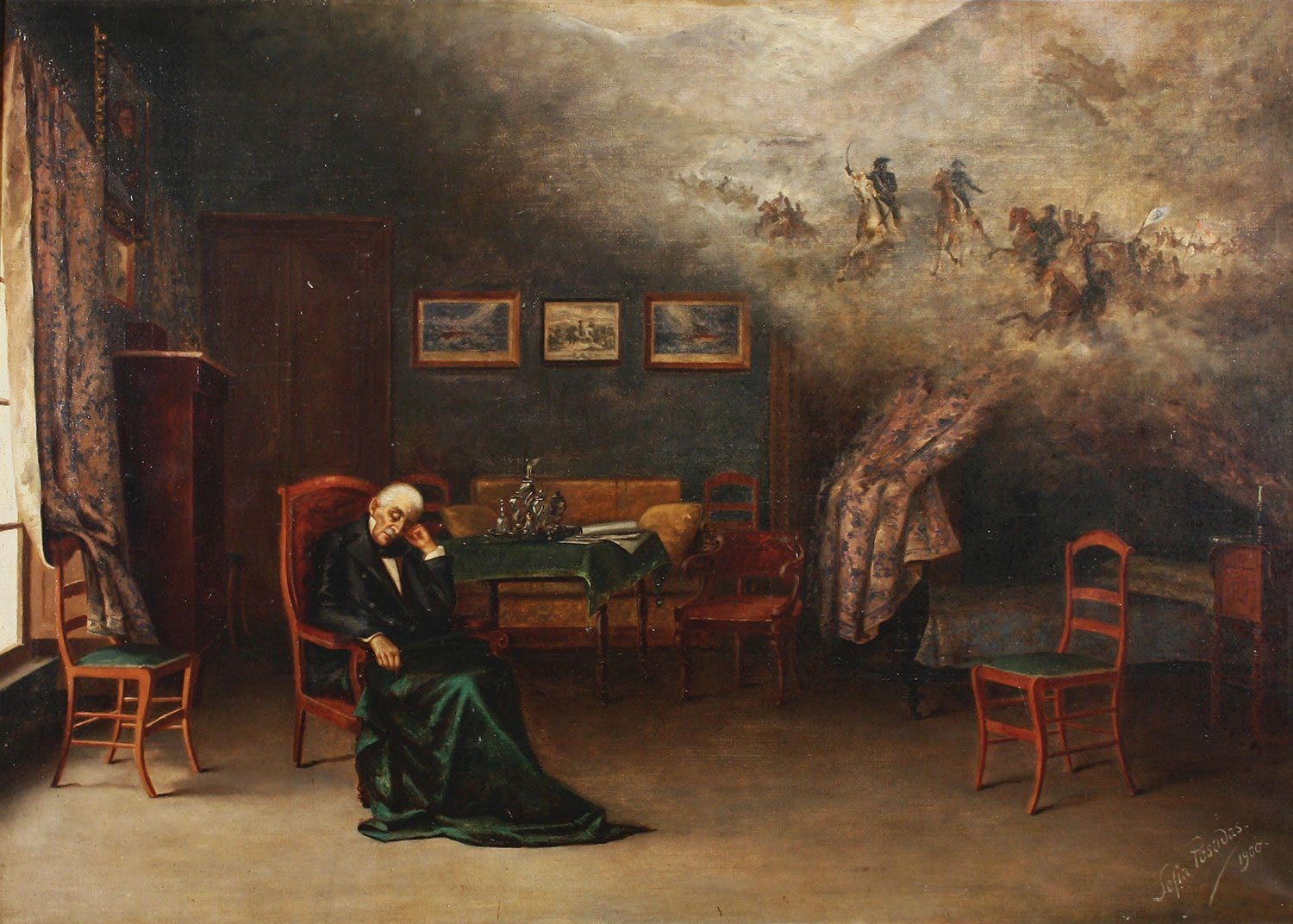
In his later years, the many maladies he had collected through the wars in Europe and South America compounded. Eventually, he was overtaken by cancer. On the 17th August 1850, he felt a cold overtake him and asked to be taken to his daughter. “Mercedes,” he said, “this is the fatigue of death.” He died later that day, surrounded by his family.
Legacies
Console yourself with the thought that however sad our death, it will be happier than our life.
—Letter of Bolívar to Fernando Peñalver
The battered reputations of both Liberators recovered shortly after their deaths. In the case of Bolívar, it took twelve years of political chaos before Venezuelans realized that he had not been so bad after all; in 1842, his remains were brought back to his beloved Caracas. San Martín had already been in the process of rehabilitation through his years of retirement, but Mercedes blocked any attempts to move his body while she lived. His remains returned from France in 1880.6


The two men remain popular in the countries they liberated, though to different degrees and with regional characters sometimes overshadowing them. From an informal survey conducted among my friends, Bolívar is dominant in Venezuela (obviously), but not in Colombia. In Bolivia, Sucre is better regarded, while in Ecuador there is a particular devotion to Manuela Sáenz (“libertadora del Libertador” and all that). From his part, San Martín is decisively popular in Argentina and well-liked in Chile, though in the latter less than O’Higgins (but more than Cochrane). In Peru, the only country where both were active, my impression is of a greater preference for San Martín over Bolívar, even though it was the latter who completed independence; this may be because imagining what San Martín might have done can always outshine what Bolívar actually did.
Outside of Latin America, Bolívar is the better-known figure (San Martín is not even that known within South America, or at least not the northern part). There may be several reasons for that: during life, he cultivated a public profile at the international level; he was also a head of state and architect of a nation, while San Martín avoided power whenever possible. Bolívar’s outspoken pan-American ideals have also kept him relevant centuries after his death, as the wish to establish a “patria grande” recurs in Latin American thought. And, more recently, his image has been appropriated by the Caracas regime as part of its “Bolivarian Revolution”, though how much its policies are consistent with Bolívar’s thought is debatable.


By far their greatest legacy are the countries that they helped liberate. Here, when our talk turn to nations, the analysis turns tricky. On a base level, it would appear like a success. These independent countries still exist, in one way or another, more than 200 years afterwards after the two men eased them into existence. Considering the graveyard of failed nations, this is no trivial feat.
In other aspects, however, the achievements appear lacking. Although the revolutionary conflicts were couched in Enlightenment language of liberalism and natural rights, their fruits were not shared equally. Instead, the main beneficiaries were the criollos, who in this manner managed to wrest control from the peninsulares and monopolize power and wealth in the new nations; as John Lynch pointed out, the revolutions were a minority rebelling against an even smaller minority. Everybody else—Indians, mestizos, pardos, slaves and poor whites—were utilized as cannon fodder, then returned to the exploitation machinery7—“same mule, new rider”8. The perpetuation of these grotesquely unequal structures is the source of many of the ills that plague Latin American to this day, if not all.
Are Bolívar and San Martín to blame for this historical injustice? It does not seem fair to put that burden on them. Bolívar, who from the two had the most influence in shaping his nation, was not even able to keep Gran Colombia together; could it be earnestly expected for them to reform their entire societies? Perhaps all that can be said is that, as far as we know, they did the best they could; can we ask from them more than they would ask of us?
Afterword
Thank you very much for reading through Parallel Lives! I hope that you got something out of it, be it enjoyment, learning or some secret third thing.
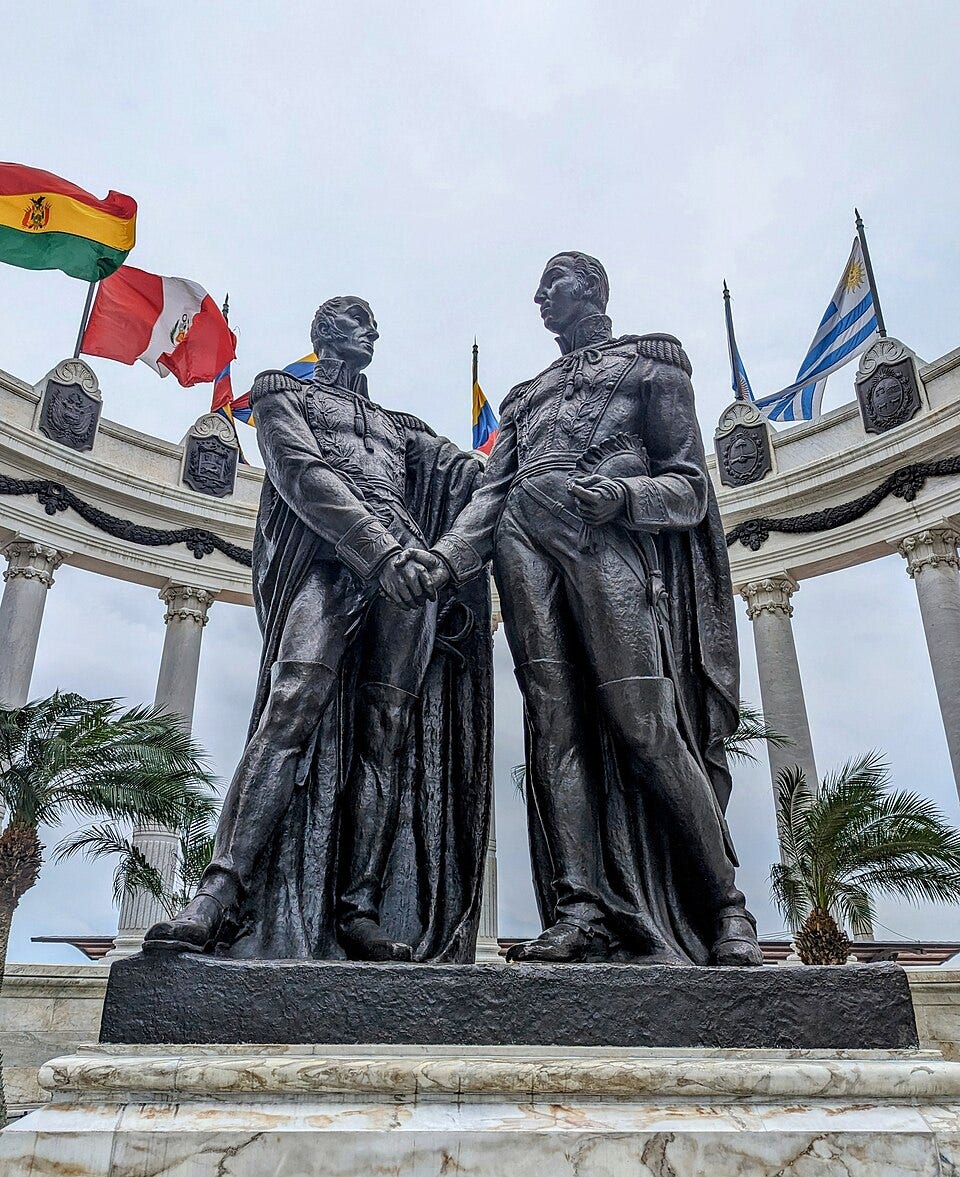
One of my objectives when I set out to write this series was to compare the two Liberators. I had had in mind some aspects I wanted to contrast: their origins and backgrounds; the revolutions they led; their friends and rivals, within and without the revolution; their women; their achievements; their ideals for the future nations. Most of all, I wanted to examine their character. I wanted to understand why they acted the way they did, how they came to converge in Peru and in Guayaquil, and how these decisions influenced their fates post-revolution.
What I most wished to avoid was a simplistic portrayal of their characters. It is easy, I think, to read the events at the surface-level and extract quick judgments: Bolívar was vain and power-hungry, San Martín was passive and timid. Such summaries don’t do them justice. Bolívar was a proud man, and thirsty of glory, that’s true; but he also sacrificed wealth and comforts to fight in the revolutionary trenches and wielded no power he did not think would benefit others. San Martín refused to take that same power for similar reasons, prioritizing the overall success of the revolution over his own political preferences. They were more complex than popular narratives suggest.
On the other hand, digging too much into the details can invite insidious lines of questioning. We are contrasting the lives and legacies of the two men; does that imply looking for which one was “better”? Is there a way to rank their achievements? Does the outcome of the Guayaquil interview mean that Bolívar “won”?
I would argue that asking whether they “won” or “lost” as if in a competition is a misleading way to approach the subject. Instead, it is more sensible to judge their success by what they wanted to achieve. Let’s look at the case of Peru, for example. San Martín’s objective was the defeat of the Spaniards; by stepping down, he made it happen. Bolívar also wanted to sweep the royalists away and reap glory from the endeavour; he came into the country and did so.
.jpg)
More broadly, each of them consciously chose different roles. San Martín wished to remain a soldier of the revolution; he cared little for power or fame beyond than a certain degree of personal reputation. On the other hand, Bolívar wanted to lead and shape policy, and cared deeply for his “glory”. Their personal goals were disparate and did not detract from one another. Can one speak of winners and losers when they are not competing for the same prize? They shared only one objective: South American liberation—an objective they achieved.
There is another aspect that they share: end of their stories. At first glance, they may seem very different: Bolívar dies on his way to exile, not long after his liberating work is done; while San Martín retires in peace in the French countryside. A closer look, however, reveals a shared thread of rejection by their home countries, though interestingly the reasons are diametrically opposed: Bolívar was exiled due to his involvement in Gran Colombian politics, but San Martín was driven off Argentina because he would not take a political stance. Damned if you do, damned is you don’t—was there any way to avoid this fate? Is “Liberator” actually the mark of a pariah?
Perhaps it is a bit too fanciful to call this fate. But it does seem true that, after a certain point, prestige can become a double-edged sword. People on the lookout of a savior will not cease to call on you to solve their problems—Bolívar was called and accepted, while San Martín refused that call. On the other hand, if the powers-that-be cannot ignore you or co-opt you, then perhaps the only option is to destroy you—this is Bolívar surrounded from all fronts and San Martín harassed by the Argentine government. The Liberators experienced these contradictions first-hand.
But allow me, dear reader, to close this afterword in a positive, if bittersweet, note. In a sense, both Bolívar and San Martín did end up getting what they wanted. Bolívar wanted glory and fame, and now he is one of the best-known, most revered Latin American figures. From his side, San Martín could not find the peace that he envisioned in Cuyo, he found it in Europe, where he could spend his days as a private person and a family man. Not a bad ending, all things considered; after all, the worker deserves his wages.
Recommended Reading
This series has been, at best, an inadequate summary of the works I have read. The selection of facts and events has been colored by what I thought would make for the best (and most interesting) introduction to newcomers to the topic. For that purpose, I had to leave out many topics due to length considerations. I had to cut, for example, a good bunch of details on Bolívar’s romantic affairs; the extent of the physical challenges of the campaigns and the accumulating illnesses of both Liberators, which here only really show up towards the end; several excellent quotes; many (and I mean many) events of great dramatic power; and characters strange and unbelievable that would need their own posts to fully do them justice.
It was a hard choice to pick what to include and what to exclude. Luckily, you don’t have to. If this series has managed to pique your interest in the period, there are many resources, online and in print, which can satisfy your curiosity. Here I will leave my recommendations with which to continue learning.
Non-Fiction
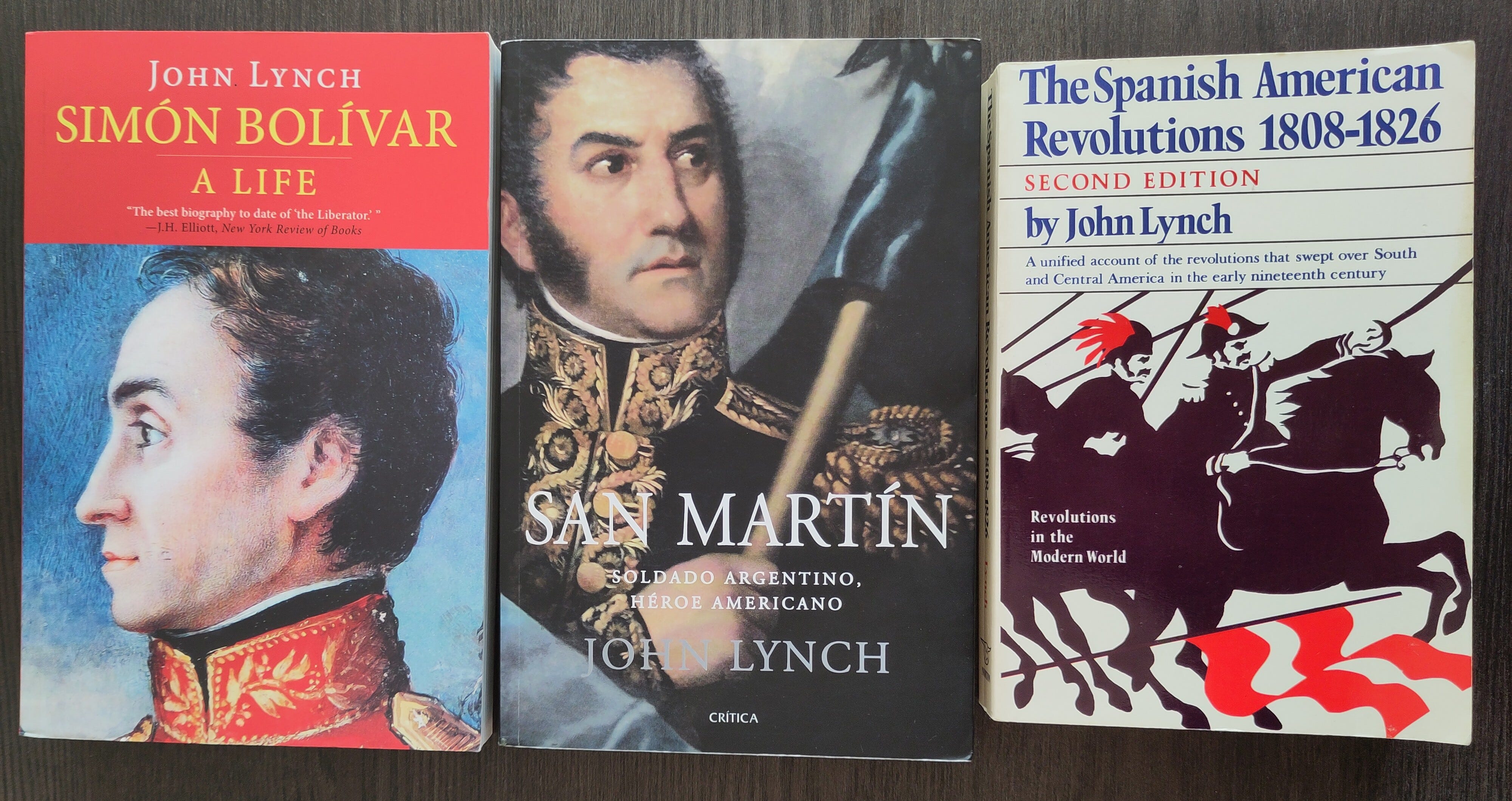
I can whole-heartedly recommend John Lynch’s works on the subject: his Spanish American Revolutions provides a good expansive overview on the subject, while his biographies Simón Bolívar and San Martín are deeper dives into the lives of the Liberators.
Fiction
Here I must sadly confess that I have not yet read that much literature set in this period. However, I can highlight the following works:
El general en su laberinto (The General in his Labyrinth), by Gabriel García Márquez. It is a re-telling of Bolívar’s last days, from leaving Bogotá to his death. It is full of García Márquez’s powerful prose and apparently was very well-researched.
Guayaquil, by Jorge Luis Borges. This is a short story about two academics of Latin American history that get some new information on the Interview in Guayaquil and their confrontation over it. Available in English here and in Spanish here.
Las lanzas coloradas (The Red Lances), by Arturo Uslar Pietri. It chronicles how the lives of a well-off family in Venezuela are upended by the carnage of the revolutionary wars. To be honest, I am not sure if it would be easy to find in an English translation, but if you find it in Spanish it may be worth your time!
I will be on the lookout for more novels/stories set in this period in the future. Reviews will be published here, so if you are interested this is your chance to subscribe!
In reality, Upper Peru and Callao refused to recognize the surrender and had to be taken by force.
By this point, Mexico and Central America had become independent by their own processes, and existed as the First Mexican Republic and the Federal Republic of Central America respectively.
The designation came from O’Leary. In his view, Bolívar was “the greatest man of the revolution”, while Santander was “the most fortunate”.
I have been using the name “United Provinces (of Río de la Plata/of South America)”, as that is how the country was officially called after the May Revolution. The term “Argentina” started to come into use between the 1820s and 1830s, becoming official in 1860.
The ship actually made it all the way to Buenos Aires, but he refused to land and had to negotiate an exit passport from aboard the ship.
Source of pictures: Paul Rousselot and Alba Ciudad.

In the case of the slaves, many countries did not offer full emancipation until many decades afterwards; in the case of the Indians, they were even worse-off than before, as many of the traditional rights were stripped away without Crown protection, often by well-meaning liberal reforms. And of course, full political enfranchisement came only much later, and in many ways it is still a work in progress.
The phrase originated in the Mexican Revolution, but is generally applicable to Latin America. Quoted by Lynch in The Spanish American Revolutions.